
A Quick Troubleshooting Guide for Hudson Valley Homeowners
In the Hudson Valley, summer heat and humidity hit fast. So when you walk inside, hit the thermostat, and nothing happens, the first instinct is to pick up the phone and call for help.
But not so fast.
Some of the most common AC problems have surprisingly simple fixes — ones you can handle yourself in just a few minutes. Before you schedule an emergency service call, run through these quick checks. You might save yourself a wait and a trip fee.
5 Things to Check Before Calling for AC Repair
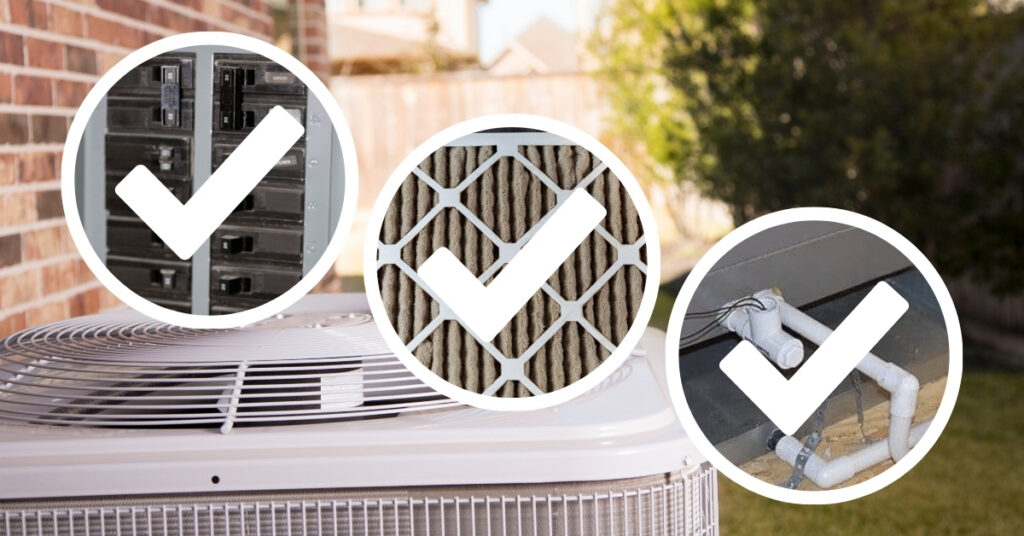
1. Look at your air filter.
This is the number one cause of air conditioning problems that homeowners don’t see coming. A clogged filter restricts airflow so severely that your system can’t cool your home properly — or may shut itself down entirely as a safety measure.
Pull your filter out and hold it up to the light. If you can’t see through it, it’s time for a new one. A fresh filter takes about 60 seconds to swap in and costs just a few dollars.
PRO TIP: Filters should be changed every 1–3 months during peak cooling season. Mark it on your calendar now so it doesn’t sneak up on you again.
2. Check your circuit breaker.
Air conditioning systems draw a significant amount of power, and breakers can trip — especially at the start of the season when your system kicks on for the first time in months. If your AC isn’t responding at all, head to your electrical panel and look for any breaker that’s been tripped to the middle or “off” position.
Reset it by flipping it fully off, then back on. If it trips again immediately, stop and call us — that’s a sign of a deeper issue that shouldn’t be ignored.
3. Check the condensate drain pan.
Your AC unit removes humidity from the air as it cools, and that moisture has to go somewhere. It drains into a pan beneath the indoor unit. If that pan fills up — due to a clogged drain line — a float switch will automatically shut the system down to prevent water damage.
Find the drain pan (usually located beneath the air handler in your basement, attic, or utility closet). If it’s full of standing water, the drain line likely needs to be cleared. You can try pouring distilled white vinegar into the drain line’s access port to break up the clog.
4. Make sure your thermostat is set correctly.
It sounds obvious — but it’s worth checking. Confirm your thermostat is set to COOL (not HEAT or FAN ONLY), and that the temperature is set below the current room temperature. If you have a smart or programmable thermostat, make sure it hasn’t defaulted to a scheduled setting that’s working against you.
Don’t forget to check the batteries too! A thermostat with dying batteries can behave erratically or stop communicating with your system altogether.
5. Inspect the outdoor unit.
Go outside and take a look at your condenser unit — the large box that sits outside your home. Make sure it’s running when the system is calling for cooling. Also check that it isn’t blocked by debris, overgrown shrubs, or anything that might be restricting airflow around it. Give it at least two feet of clearance on all sides.
Still Not Working? That’s What We’re Here For.
If you’ve worked through this list and your cooling system still isn’t performing the way it should, it’s time to bring in a professional. The team at Nebrasky Plumbing, Heating & Cooling has been diagnosing and repairing HVAC systems across the Hudson Valley for decades — and we’ll tell you straight what’s going on, with no guesswork and no pressure.
Don’t sweat it out waiting to see if the problem resolves itself. Call Nebrasky at 800-796-6853 to get your AC back up and running fast!